 As the previous "Panda kopanda" short movie, this one is a bit bad, but already shows a lot of inspirations, amongst which Little Nemo and "Goldilocks And the Three Bears". And as its predecessor, one can already note how full of inspiration this movie was for Miyazaki's Totoro.
Thursday, October 15, 2009
"Panda kopanda : amefuri circus no maki" [fr="Panda Petit Panda"] ~ 6/10
As the previous "Panda kopanda" short movie, this one is a bit bad, but already shows a lot of inspirations, amongst which Little Nemo and "Goldilocks And the Three Bears". And as its predecessor, one can already note how full of inspiration this movie was for Miyazaki's Totoro.

"Panda kopanda" [fr="Panda Petit Panda"] ~ 5/10
Distributed in France as one feature film with its sequel ("Panda kopanda : amefuri sâkasu no maki"), this movie is one of the early contributions between Takahata and Miyazaki, a long time ago when Studio Ghibli did not even exist.It is a bit strange to see how *bad* these early works were, full of illogisms and improbable things, in a world were adult reason with children without an ounce of maturity.
Miyazaki's stories have never been realistic at all but his more recent movies have so many other qualities that the screenplays cannot be blamed.
Anyway, "Panda kopanda" is still very interesting as you can see how Totoro got one of his main (self-)inspiration 15 years before it was actually made.
And the music is like a drug for young children.
Wednesday, October 14, 2009
"Fame" ~ 3/10
 Rhyming with "shame" and spelling like "hunger" in italian, this useless movie is just a 1 hour and 47 minutes long commercial for the New York City Performing Arts School, almost as ridiculous as a Crédit Agricole commercial from the eighties...
It is just full of travellings Jean-Luc Godard might call "immoral", and somehow always less interesting than any episode of the Actors Studio.
"Rose et noir" ~ 6/10
 The very last plan is what might be called cinema. The rest is only regular anachronical comedy with very few very funny moments, and a few extremely silly jokes. Finally it proves to be a little more intelligent than the regular american comedy, but not that interesting. Only worth watching when you want a light comedy but not something completely "brainless".
Tuesday, October 13, 2009
"The Box" ~ 9/10
 This movie Richard Kelly has been working on for years is finally done, adapted from a short story ("Button, Button") written by the science-fiction master Richard Matheson - to whom Kelly bought the rights in person, with his own money, a long time ago.
So the film starts on a cruel dilemma (very few dilemma are not...), and soon we discover there was something bigger underneath the very dilemma.
 The way the period is described takes us back in time as if the movie itself had actually been _made_ in some creepy part of the american seventies. The subject of Cold War is never approached, yet this movie talks a lot about "fear" and "fears" (something Richard Kelly likes to do) as it was all over America then. This time it is not about teenager fears like in his two previous movies, but something more adult, and more intimate.
Frank Langella is a huge actor and proves it here once again ; Cameron Diaz is not that bad either...
As always with Matheson, this story here is more psychological rather than purely "science-fictive", but that's exactly what Richard Kelly needed as a "draft", to make another great movie full of implications and references.
The music was also great for the fears it conveyed, but not in the same way the "Donnie Darko" soundtrack did. Maybe that's what I miss the most.
Tuesday, October 6, 2009
"The Cove" [fr="La Baie de la honte"] ~ 10/10
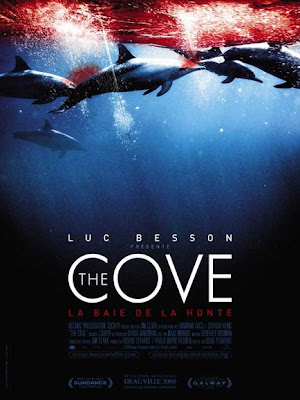 This movie is not a regular documentary involved in protection of the environment or the endangered species. It is indeed an action documentary (not exactly à la Hara Kazuo but I wanted to use the expression here), with a whole "commando" of (american) men and women trying to show and spread to the world the hideous and hidden truth about a small (japanese) community of animal murderers (that is murderers OF animals), covered by a whole bunch of officials and politicians. Yes, it might sound strange to some of us : this is NOT fiction and yet the good guys are american ! (just kidding...)
Well, in fact, the good guys might be anyone watching this movie and showing the slightest political reaction - something Japanese people are not always very good at, but let's hope they will, this time, actually do something, anything (please...).
And above all, it shows how - only ? - passion can really change things in a world where politics are solely a matter of dispassionate businessmen.
Maybe, if I had to be _nerder_ there, two things lacked in this film - but it does not prevent it from being a masterpiece documentary !
Firstly perhaps, an explanation about the fact that iruka ("dolphin" in japanese) can be written with several chinese ideograms : 海豚 (which means "sea pork"...), or 鯆 (an ideogram that, as the one for "whale", kujira 鯨, is compound with the radical of the fish on the left : 魚, thus classifying those intelligent mammals as mere fishes...).
Secondly, I was wondering how this so-called "tradition" (fishing dolphins by slaughtering them) might be a good thing for yakuza. The japanese mafia is mentioned only once in the movie. Still, aren't those fishermen involved in any criminal organisation bigger than just their little town of Taiji PLUS the japanese government's interests in struggling against the rest of the world ? Tradition and nationalism being a huge part of the yakuza spirit, I just wondered if the film crew did not develop the idea furthermore 1) because this very idea was foolish, or 2) because it would be foolhardy to pursue an enquiry involving the yakuza ?
I would like to add here that, even without recalling the numbers exactly, it seems that the biggest part (like, two thirds or so) of the fish stocks bought everyday for the restaurants in the Consumption Empire of Japan, are just not consumed at all, then dumped daily, consequently WASTED daily, and therefore destroying the planet twice or thrice faster than "normal" fishing...
Finally I would just add, as a good "green" nerd, that this movie is no exception to the rule stipulating that any documentary made after "Koyaanisqatsi" (that is to say since 1982) has to feature a fast-motion scene.
PS : I am actually glad to see that Luc Besson, one of the WORST popular director in french cinema, who according to me wrote only two good movies in his whole career ("Leon" and "Taken"), now seeks to buy himself a consciousness by distributing very good documentaries such as "Home" or "The Cove" with his production company Europa Corp.
Sunday, October 4, 2009
"Mary and Max" [fr="Mary et Max."] ~ 10/10
 Since 3d animation almost became the only way of making feature films, it is so rare to see a "good old" handmade animated movie. Tim Burton and Henry Selick's "The Nightmare Before Christmas" probably was the biggest success in this category, closely followed by Aardman Animation's productions ("Wallace & Gromit"). Now it seems that a "new" director came to this wonderful world of animated clay and stop motion : Adam Elliot's "Mary and Max" is a masterpiece.
Indeed, it features a whole world of dark (and brown) characters with dark (and brown) ideas ; the hours spent to give those life are not the fruit of a computer's work, but mostly _human_ work.
Moreover, a movie opening with Penguin Cafe Orchestra's "Perpetuum Mobile", following its rythm, and featuring variations of the same piece all along the story, cannot be less than a very good one, and obviously _is_ a truly beautiful piece of art. And finally, the fact that the character played by (the so great) Philip Seymour Hoffman has "aspies" ought to be considered an outstanding boldness.
Subscribe to:
Posts (Atom)
